
Table of Contents
Introduction
Living with a phobia or deep-rooted fear can be exhausting. It affects more than just the moments of panic; it shapes the decisions you make, the places you avoid, and the life you feel able to live. Whether your fear feels small to others or completely controls your daily routine, the impact on your confidence and freedom is very real. The good news is that fear is not a life sentence.
Hypnotherapy offers one of the most effective, evidence-backed approaches to resolving fears at their source without years of talk therapy, without medication, and without forcing yourself through uncomfortable exposure. By working directly with the subconscious mind, where fear responses are stored and triggered, hypnotherapy creates lasting change from the inside out. Here’s everything you need to know about how it works and whether it’s right for you.
What is hypnotherapy for fears and phobias?
Hypnotherapy is a therapeutic technique that uses a guided hypnotic state, a deeply relaxed, focused state of awareness, to access the subconscious mind. Unlike the conscious mind, which is analytical and guarded, the subconscious is where phobias, irrational fears, and conditioned fear responses are stored.
When you experience a phobia, your brain has learned to associate a stimulus (a spider, a plane, a crowd) with danger even when no real danger exists. Hypnotherapy works by gently re-examining and reframing that association at the subconscious level, replacing the fear response with calm, rational perception.
Hypnosis vs hypnotherapy for phobias what's the difference?
Hypnosis
Hypnotherapy
Hypnotherapy is the therapeutic application of hypnosis. A trained hypnotherapist uses the hypnotic state to apply specific techniques, such as regression, reframing, and suggestion therapy to address a clinical issue like a phobia, anxiety, or trauma response.
For treating fears and phobias, both elements are needed: the hypnotic state (hypnosis) creates the window, and the therapeutic techniques (hypnotherapy) do the healing work. At Bliss Psycho Hypnosis, every session combines both.
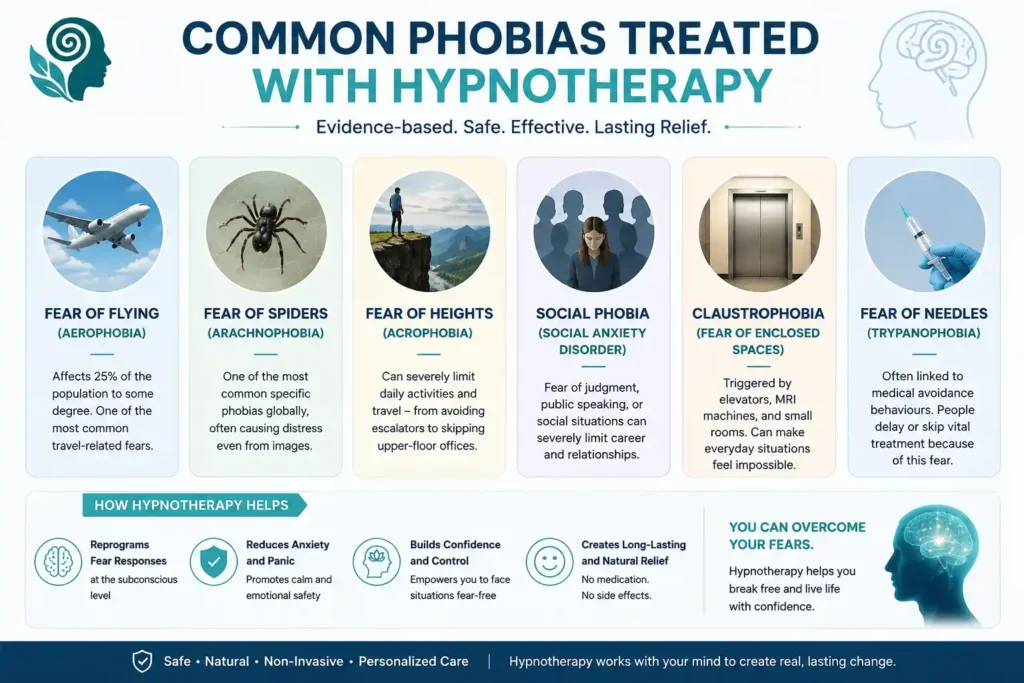
Common fears and phobias treated with hypnotherapy
Fear / Phobia | Medical Term | Description |
Fear of flying | Aerophobia | Affects 25% of the population to some degree one of the most common travel-related fears globally |
Fear of spiders | Arachnophobia | One of the most common specific phobias globally, often causing distress even from images |
Social phobia | Social anxiety disorder | Fear of judgement, public speaking, or social situations can severely limit career and relationships |
Fear of needles | Trypanophobia | Often linked to medical avoidance behaviours people delay or skip vital treatment because of this fear |
Fear of heights | Acrophobia | Can severely limit daily activities and travel from avoiding escalators to skipping upper-floor offices |
Fear of failure | Atychiphobia | Rooted in deep subconscious beliefs about self-worth often holds people back from pursuing goals |
Health anxiety | Hypochondria | Persistent fear of illness or death that leads to constant checking and reassurance-seeking |
Claustrophobia | Fear of enclosed spaces | Triggered by elevators, MRI machines, and small rooms can make everyday situations feel impossible |
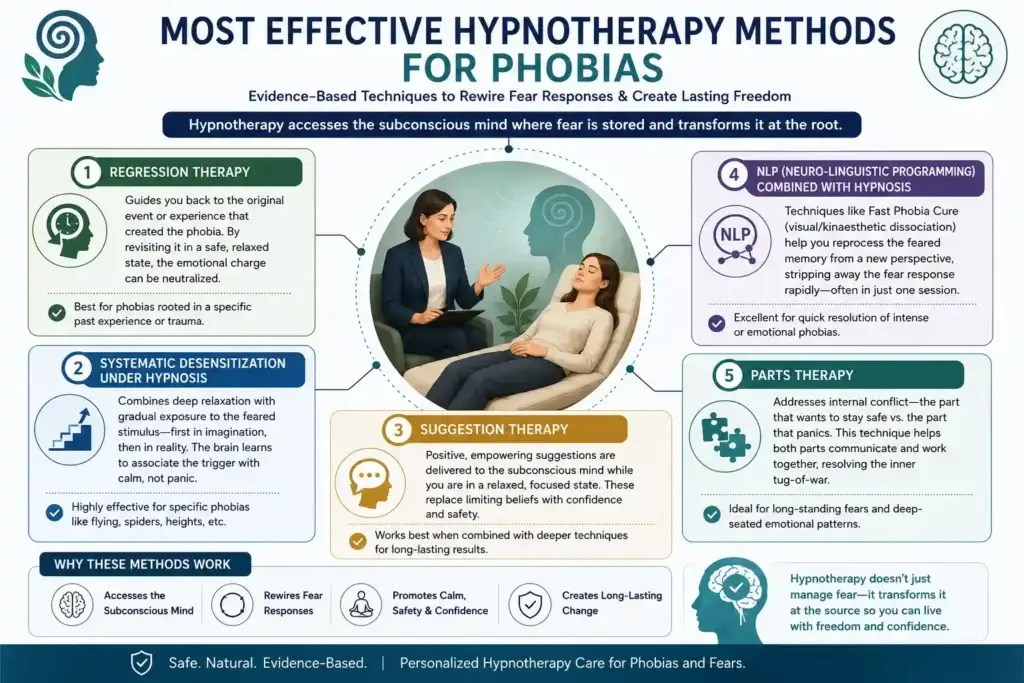
Most effective hypnotherapy methods for phobias
1. Regression therapy
2. Systematic desensitization under hypnosis
3. Suggestion therapy
4. NLP (Neuro-Linguistic Programming)
5. Parts therapy
What to expect in a hypnotherapy session for fears and phobias
Many people feel nervous about their first hypnotherapy session, often because of misconceptions from stage hypnosis or films. In reality, it begins with a simple conversation. Before anything else, your hypnotherapist will speak with you in detail about your fear when it started, how it affects your daily life, and what you want to feel instead. This is called the intake or discovery session. There is no judgment here, all fears are valid, and all fears are treatable.
During the session, you will be guided into a state of deep physical and mental relaxation similar to the feeling just before sleep. You are NOT unconscious. You remain fully aware and in control at all times. You can speak, move, and come out of a trance whenever you choose. While you are in this relaxed state, your hypnotherapist will use one or more proven techniques to gently work on the root of your fear.
After the session, most clients feel calm, lighter, and sometimes surprised by how natural the experience felt in the best possible way. The real shifts often happen in the days that follow, as the subconscious mind integrates the new patterns. And one thing is always true you cannot be made to do or say anything against your will during hypnotherapy. The idea of losing control is a myth. You are always the one in charge.
Online hypnotherapy for phobias does it work?
Yes. Online hypnotherapy is just as effective as in-person sessions for the vast majority of fears and phobias. The hypnotic state doesn’t depend on physical proximity it depends on your relaxation and trust in the process, both of which can be achieved over a secure video call.
Online sessions offer several practical advantages: no travel time, the comfort of your home (which itself can aid relaxation), and the ability to work with the best hypnotherapist for your needs regardless of geography.
Bliss Psycho Hypnosis offers online hypnotherapy sessions for fears and phobias that are fully secure, private, and as effective as face-to-face work.
How many sessions will you need?
The number depends on the complexity and root cause of the fear. As a general guide:
Phobia Type | Examples | Sessions Needed |
Simple specific phobia | Spiders, needles, dogs | 1 to 3 sessions |
Situational phobia | Flying, driving | 2 to 4 sessions |
Complex or deep-rooted fear | Linked to trauma or multiple triggers | 4 to 8 sessions |
Social phobia / generalised anxiety | Social anxiety, health anxiety | 5 to 10 sessions |
Many clients experience significant relief within their first two sessions. Unlike some therapies, hypnotherapy is designed to produce change quickly rather than over years.
Conclusion
Fears and phobias can feel overwhelming, but they are not permanent. Every phobia has a root cause stored in the subconscious mind. And what the subconscious has learned, it can unlearn.
Hypnotherapy doesn’t just teach you to manage your fear, it helps you resolve it. No years of talk therapy. No medication. Just lasting change at the root level.
At Bliss Psycho Hypnosis, every session is personalized to your fear, your history, and your goals at your pace, without pressure. The fear you carry today does not have to be the fear you carry tomorrow.
Frequently asked questions
Yes. Hypnotherapy is a gentle, non-invasive therapy with no side effects. It is recognized by the British Medical Association and supported by a growing body of clinical research. A qualified hypnotherapist will always tailor the approach to your needs.
For specific phobias, hypnotherapy often produces lasting resolution rather than just management. Results vary by individual and the depth of the fear, but many clients report their phobia no longer affecting them years after treatment.
CBT works at the conscious, rational level of understanding and challenging thought patterns. Hypnotherapy works at the subconscious level, where the emotional root of the phobia lives. Many clients find hypnotherapy faster and more directly effective, particularly when the fear feels irrational and doesn't respond to logic.
Skepticism is common and doesn't prevent hypnotherapy from working. The hypnotic state is a natural phenomenon similar to daydreaming or deep absorption in a book. Most people who say they "can't be hypnotized" enter trance easily once they understand what to expect.
For the majority of fears and phobias, yes. The therapeutic relationship and the quality of the hypnotherapist matter far more than whether you're in the same room. Online sessions allow you to work from the comfort and safety of your home, which can actually deepen relaxation.