
Table of Contents
Introduction
You have tried deep breathing. You have downloaded the meditation apps. Maybe you have even sat through therapy sessions. Yet the racing thoughts at 2 a.m. still find you. The chest tightness before a big meeting still shows up uninvited.
If this sounds familiar, you are not alone. And you are certainly not broken. You may simply be trying to solve a subconscious problem using only conscious-level tools.
That is where hypnotherapy for anxiety and stress relief enters the picture. Thousands of people who had tried everything are finally finding the calm they had been searching for. In this guide, you will learn exactly how hypnotherapy works, who it helps, what a real session feels like, and what the science actually says.

Why Anxiety and Stress Are Harder to Escape Than You Think
Most people blame their circumstances for their anxiety. A demanding boss. A difficult relationship. Financial pressure. The relentless pace of modern life. While circumstances do matter, they are rarely the whole story.
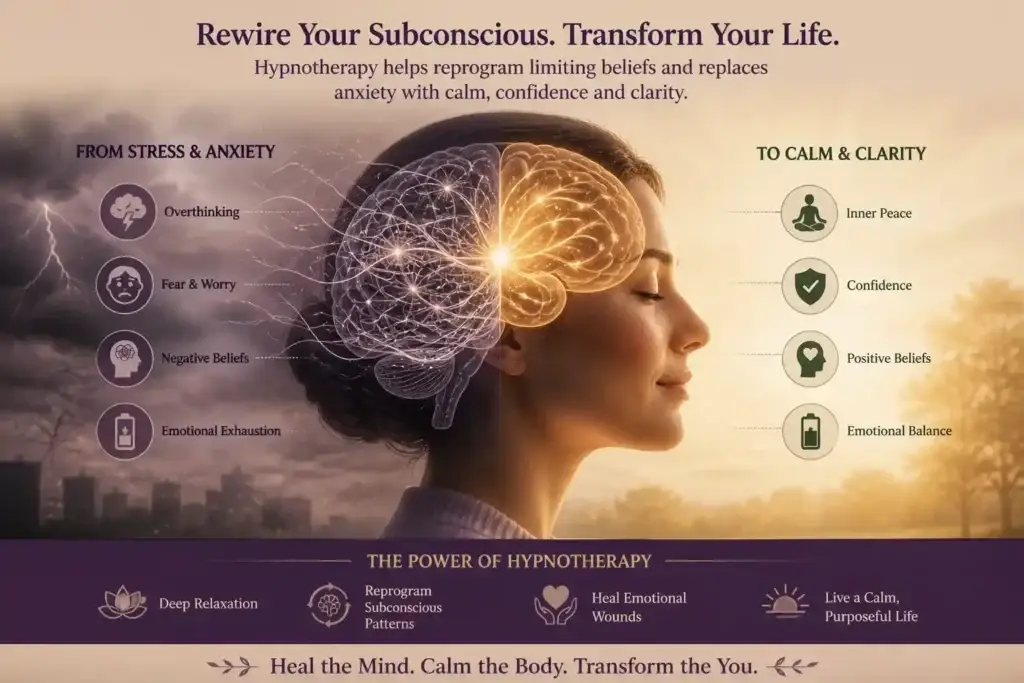
Here is what is actually happening. Your brain has learned to be anxious. Repeated experiences of stress, disappointment, and uncertainty have trained your nervous system to respond with alarm, even when no real threat exists. Over time, this becomes automatic. You do not choose to overthink. Your subconscious mind does it for you, because it believes it is keeping you safe.
This is why journaling, positive affirmations, and even traditional talk therapy sometimes fall short. They work at the conscious level. But anxiety lives deeper, in the subconscious patterns your mind has been quietly running for years.
The Hidden Cost of Living in Fight-or-Flight Mode
When stress becomes chronic, the body pays a steep price. The sympathetic nervous system gets stuck in overdrive, flooding your body with cortisol and adrenaline day after day.
The results show up everywhere. Disrupted sleep. Difficulty concentrating. Emotional outbursts over small things. Physical tension in your neck and shoulders. Digestive problems. A persistent sense of dread that is hard to explain to others.
For students and working professionals between the ages of 20 and 45, this is increasingly the norm. Academic pressure, career competition, relationship stress, and social media noise have created a generation that appears deeply capable on the outside, while being silently exhausted on the inside.
What Is Hypnotherapy, Really?
When most people hear the word hypnotherapy, they picture a swinging pocket watch or someone being made to cluck like a chicken on a stage show. That is entertainment hypnosis, and it has almost nothing to do with clinical hypnotherapy.
Therapeutic hypnotherapy is a structured, evidence-informed process. A trained therapist guides you into a state of deep mental relaxation and focused attention. In this state, your critical and analytical conscious mind relaxes its grip. The subconscious then becomes far more receptive to positive, healing suggestions.
You remain fully aware throughout. You cannot be made to do anything against your will. You are not under someone’s control. You are simply in a highly focused, deeply relaxed state. Most people describe it as profoundly peaceful.
Think of it less like sleep and more like that gentle, floating space just before you drift off, when your mind is open and unusually clear. That is the space where real change happens.
How Hypnotherapy Works on Anxiety and Stress at the Root
Rewiring the Subconscious Stress Response
Your subconscious mind is remarkably loyal. It stores every significant emotional experience you have ever had and builds automatic reactions from them, all designed to protect you.
A child who was frequently criticised may develop a subconscious belief that says, “I am never good enough.” As an adult, that same belief runs quietly in the background. It generates anxiety before every presentation, every social interaction, every moment of perceived judgment.
Hypnotherapy accesses these deeply stored patterns and, through guided suggestion and visualisation, begins to rewrite them. The therapist works with you, not on you, to gently release the old beliefs driving your stress and replace them with more accurate, empowering responses to life.
A 2019 meta-analysis found that individuals who received hypnotherapy showed greater anxiety reduction than approximately 79% of control participants. That is a significant outcome that reflects just how powerfully this process shifts deeply ingrained patterns.
Calming the Nervous System, Not Just Masking Symptoms
Beyond psychological reprogramming, hypnotherapy has a direct and measurable physiological effect. Entering a hypnotic state activates the parasympathetic nervous system, your body’s natural rest-and-digest mode. This directly counters the chronic fight-or-flight state that anxiety sufferers live in.
Heart rate slows. Muscle tension releases. Cortisol levels begin to drop. Breathing deepens on its own.
What makes this different from simply relaxing with a cup of tea is that the changes carry over into daily life. Over a course of sessions, your nervous system learns a new baseline. One built on calm and resilience, rather than constant alarm.
What a Real Hypnotherapy Session Feels Like
One of the most common reasons people hesitate to try hypnotherapy is that they simply do not know what to expect. So let us walk through it.
Your first session begins with a conversation. Your therapist wants to understand your specific experience of anxiety or stress, your triggers, your history, and your goals. Many clients report feeling genuinely heard and understood in a way they have not experienced before.
From there, your therapist gently guides you into relaxation through calming language, breathing exercises, or a progressive relaxation technique. Your body softens. Your mind quiets. Most people describe this not as going under, but as going inward. A deep, comfortable awareness where the usual mental chatter simply settles.
In this receptive state, your therapist introduces therapeutic suggestions tailored to your specific needs. These might involve releasing the fear of failure, building genuine confidence, letting go of a past hurt, or simply allowing your body to feel safe in the present moment.
The session closes with a gentle, grounding return to full awareness. Most clients leave feeling lighter, calmer, and noticeably clearer than they have felt in months.
Sessions generally last between 60 and 90 minutes. At Bliss Hypnotherapy in Surat, Dr. Jyoti Kulkarni begins every client relationship with this kind of unhurried, personalised intake, because your story matters before any therapy begins.
“I was feeling sad most of the time and very insecure. After 2 to 3 sessions with Dr. Jyoti, I feel really very good.” – Kavita Sawant, Bliss Client *****
The Science Behind Hypnotherapy for Anxiety
Hypnotherapy is no longer a fringe practice. It has earned a respected place in evidence-based mental health care, backed by a growing body of peer-reviewed research.
A study published in Frontiers in Psychology (2024) confirmed that hypnosis was effective in reducing competitive anxiety and stress compared to control groups. A large-scale retrospective study published in npj Digital Medicine (2025) analysed over 282,000 stress reduction sessions across 84,000 users and found consistent, significant stress reduction across the first ten sessions.
A meta-analysis published in the International Journal of Clinical and Experimental Hypnosis found that hypnotherapy produced better outcomes when combined with psychological approaches like CBT. This is precisely the integrative model that high-quality clinicians use today.
Research also shows that two thirds of the population are capable of entering a hypnotic state effectively, making it one of the most broadly accessible therapeutic tools available.
Key Takeaway: Hypnotherapy is a scientifically studied intervention with measurable effects on the brain, the nervous system, and emotional wellbeing. It is exactly the science-backed approach Dr. Jyoti Kulkarni brings to every session at Bliss Hypnotherapy, Surat.
Who Can Benefit from Hypnotherapy?
Hypnotherapy for anxiety and stress relief is remarkably versatile. The people who benefit most are often those who have already tried other approaches and found them insufficient on their own.
Working Professionals and Students Under Pressure
If you are navigating the pressures of a competitive career, academic performance, or the constant expectation to achieve, and no amount of productivity advice or mindfulness content actually quiets the noise, you are likely dealing with subconscious patterns that need a deeper approach.
Hypnotherapy is particularly effective for performance anxiety, fear of failure, impostor syndrome, and the kind of chronic, low-grade stress that quietly erodes your energy, confidence, and joy over time.
Emotional Healing After Heartbreak or Trauma
Anxiety does not always come from work pressure. Sometimes it arrives after a painful relationship, a significant loss, a betrayal, or a trauma that left its mark in ways you cannot quite articulate.
Hypnotherapy for emotional healing works by accessing the emotional memory at its source. It processes pain at a subconscious level and helps the nervous system understand that the past is over and the present is safe. Many clients who have struggled with grief, heartbreak, low self-worth, or unresolved trauma describe hypnotherapy as one of the most profoundly healing experiences of their lives.
Parents Seeking Help for Their Child's Anxiety or Confidence
Children and teenagers are not immune to anxiety. Pressures around school performance, social acceptance, and a digital world of constant comparison have made anxiety among young people a growing concern.
Hypnotherapy adapted for children and adolescents can be highly effective for building confidence, reducing test anxiety, addressing behavioural patterns, and helping young people develop a healthier relationship with their emotions. At Bliss, Dr. Jyoti Kulkarni’s dedicated Child Counselling Therapy is designed to do exactly this, in a safe, compassionate, and age-appropriate setting.
Not sure which service is right for you? Bliss offers a personalised consultation to help you understand your options before you commit to anything. Call (+91) 6356349768 or Contact Us
Hypnotherapy vs. Other Approaches: Why It Goes Deeper
There is no shortage of tools for managing anxiety. CBT, medication, meditation apps, journaling, yoga. All of these have genuine value, and hypnotherapy is not a replacement for any of them.
What makes it distinctive is the level at which it operates. Most stress management techniques work at the conscious level. They help you think differently, breathe better, or behave more mindfully in the moment.
Hypnotherapy works at the subconscious level, where the patterns driving anxiety actually live. It is the difference between painting over a crack in the wall and fixing the foundation beneath it. When combined with CBT or other therapeutic approaches, hypnotherapy consistently produces better outcomes than any single method used alone.
Common Myths About Hypnotherapy, Busted
“I will lose control and say things I do not want to say.” This is completely false. You remain aware and in control throughout. Hypnotherapy is a collaborative process. Your therapist works only with your consent and toward your stated goals.
“It only works on weak-minded people.” Also false. Hypnotisability is actually associated with focus, creativity, and emotional intelligence. Qualities that many highly capable and driven individuals already possess.
“The effects will not last.” Hypnotherapy is not a single magic session. Like any meaningful change, it builds over time. Most clients report that the shifts they experience in their self-perception and stress responses are lasting, not temporary.
“I cannot be hypnotised.” Research indicates that approximately two thirds of people respond well to hypnosis. Those who approach it with openness and willingness, which describes most people who seek it out, tend to have very good results.
How Many Sessions Does It Take?
There is no universal number, because every person’s history, patterns, and goals are different. That said, for anxiety and stress-related concerns, most clients experience noticeable improvement within 4 to 8 sessions. Some report meaningful shifts after just 2 or 3.
The first session is largely exploratory. Your therapist builds rapport, understands your specific patterns, and begins the relaxation process. Subsequent sessions go progressively deeper.
Between sessions, many therapists provide self-hypnosis techniques or guided recordings to reinforce the changes in your own time. The realistic expectation is not instant transformation, but progressive, cumulative change. A gradual sense of lightness, calm, and growing self-trust.
Conclusion
Anxiety and stress do not have to be permanent fixtures in your life. They are patterns, and patterns can change. Hypnotherapy works not by suppressing what you feel, but by going to the source of why you feel it, and gently, permanently rewriting the story.
At Bliss Hypnotherapy and Psychotherapy Clinic in Surat, this process is guided by Dr. Jyoti Kulkarni, one of India’s trusted hypnotherapists and psychotherapists. She holds a Ph.D. focused specifically on anxiety and depression, brings over 5 years of clinical experience, and has maintained a 95% client satisfaction rate across 500 or more lives transformed.
Every session at Bliss Psycho Hypnosis is personalised to your specific challenges, conducted in a completely safe and confidential environment, and designed to produce real, lasting results rather than temporary relief.
Whether you are a student overwhelmed by pressure, a professional running on empty, or someone quietly carrying emotional pain you have never been able to put down, Bliss is built for you.
Frequently Asked Questions
Yes. When practised by a trained and certified professional, hypnotherapy is a safe, non-invasive therapeutic technique. It does not involve medication, and there are no known harmful side effects.
Yes. While hypnotherapy is particularly well-evidenced for anxiety and stress, it is also used effectively for depression, low mood, and emotional healing, especially when combined with other therapeutic approaches.
Hypnosis refers to the trance-like state of deep relaxation and focused attention. Hypnotherapy is the therapeutic application of that state, combining hypnosis with psychotherapy to address specific emotional or psychological challenges.
Yes. Research supports that online hypnotherapy is equally effective as in-person sessions for anxiety and stress-related concerns. Many clients find they relax more deeply in the comfort of their own environment.
Meditation involves quieting the mind and observing thoughts without engagement. Hypnotherapy directs the focused mind with purpose, introducing specific therapeutic suggestions and guided imagery to produce targeted change at a subconscious level.